Risley Prism Beam Steering Controller
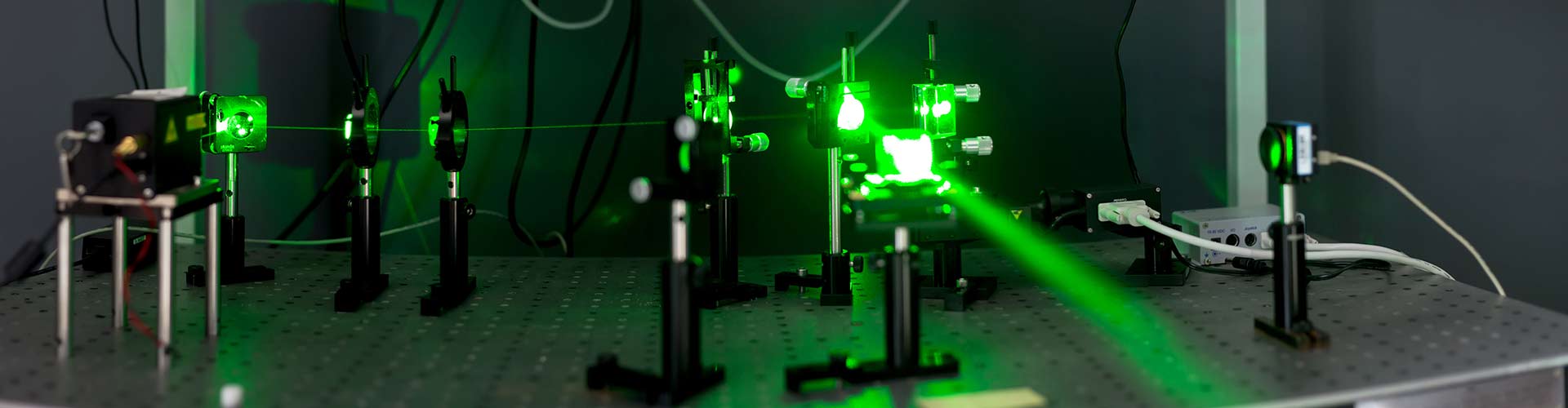
This project involved the development of an advanced control system for optical beam steering using Risley prisms. Risley prism beam steering systems use two rotating prisms to direct a light beam, offering advantages in terms of compactness and reliability compared to traditional gimbal-based systems.
A significant challenge in these systems is the presence of "blind spots" - areas where the beam cannot be directed due to the physics of the prism configuration. My work focused on developing novel algorithms to minimize these effects of both blind spots and singularities through control techniques.
The control system implemented was successfully able to direct a laser through the whole field of regard without experiencing singularities. Techniques applied similarly mirror those used to avoid singularities in high dimensional redundant robotic manipulators.
How It Works
Risley Prism Beam Steering
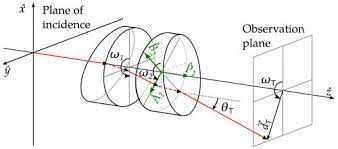
The beam steering system uses two rotating prisms to redirect a laser beam in a precise direction. Each prism adds a refractive angular deflection to the beam in addition to it's angle of incidence. For example, say a particular prism is a 7 degree refraction. If it were to pass through a single prism it would deviate 7 degrees from the angle of incidence. If it were to pass through another prism of the same orientation, it would exit the second prism at 14 degree incidence. On the other hand, if it were to pass through a second prism of opposite orientation, the angular deflection would be negated and the exit beam would have the same angle as the original incidence.
Thus through precise rotation of a series of prisms, a beam can be effectively steered to any direction within the field of regard. This results in a steering system with a much smaller footprint and higher bandwidths than typical gimballed approaches.
Control Methodologies
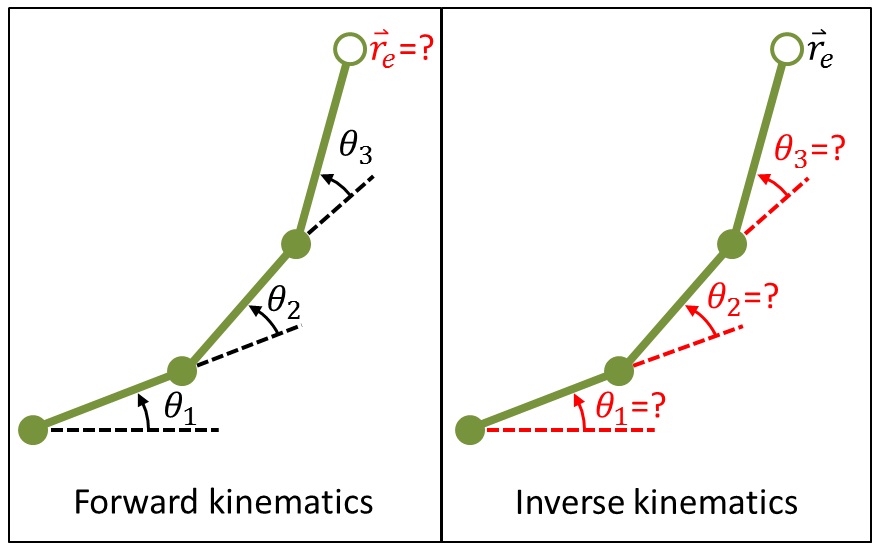
A key challenge presented by controlling this Risley prism is the highly non-linear coupled nature of controlling the system. Additionally, as more prisms are added, in theory more performance can be achieved, but the control problem becomes more difficult due to higher coupling, increased non-linearity, and increased redundancy. The math behind the control follows very simiilarly to a redundant manipulator where a forward kinematics model is used and then inverted to acheive an inverse kinematics model.
The forward kinematics model is easy enough to arrive at using simple optical ray tracing. This can be used to find the end position of the beam in both angular and Cartesian space. The inverse model is rather tricky to find having to find the Jacobian of the forward model.
Singularity Avoidance
Much like redundant robotic manipulators, this system experience singularities where small changes in desired beam direction require large rotations of the prisms. To address this, a deconfliction strategy was applied which uses a look-up table to determine the optimal prism orientation for any desired beam direction. While adding more prisms makes path planning and control more difficult, it does provide an avenue to have more options to avoid singularities. Additional strategies to circumvent singularities match the state of the art methods used in robotic manipulators.
Key Achievements
- Developed a control system for a high precision optical beam steering system in both angular and cartesian space
- Created algorithms for calculating optimal prism orientations for any desired beam direction, overcoming the presence of singularities and blind spots
- Implemented a real-time control system for high-precision prism rotation
Challenges
- Mathematical complexity in modeling prism beam paths (difficult to invert for reverse kinematics)
- Need for highly precise control to match capabilities of precise actuators
- Requirement to maintain beam quality and path length throughout the steering range
- Computation of optimal prism orientations in real-time (Makes iterative solutions difficult)
Solutions
- Developed a psuedo-inverted mathematical model of the ray traced beam path through a series of prisms
- Implemented high-precision motor control with feedback compensation
- Created a look-up table approach for real-time computation of optimal prism orientations
- Used deconfliction techniques to avoid singularities in control
Results
- Successfully steered a laser through the whole field of regard while dramatically reducing singularity frequency
- Provided a precise control scheme to be leveraged in further Risley Prism work
- Was able to leverage control techniques from redundant robotic manipulators to achieve a high-precision control scheme
- Resulted in co-author of an adjacent paper to Applied Optics
- Was unable to derive control scheme which maintains near constant path length