
Neural Network Sensory Optimization
This research project focused on developing a novel approach to sensor optimization in control systems. Historically, control engineers will simply design their sensing architectures to maximize the observability of the system. Interestingly, this approach is not what we see in nature. Natural sensory systems which have evolved over millions of years instead maximize the energy transfer through the system. This is done by optimizing their sensing to maximize the Hankel singular values of the open loop system. The Hankel singular values provide a metric for the amount of energy moving through the system by looking at the observability and controllability gramians of the system. Thus by maximizing the hankel singular values of engineered systems, we are optimizing the energy flow through the system much like nature. Additionally, there are interesting closed loop implications found from maximizing certain metrics related to the Hankel singular values.
This optimization problem is inherently non-convex and thus very difficult to solve using traditional optimization techniques such as linear matrix inequalities or traditional gradient descent. This project uses a neural network optmization implementation to optimize the sensing architecture according to different optimization criteria. By transforming the optimization into a higher feature space through neural network embedding, optimizers like ADAM are able to typically provide a global optimum in a reasonable time frame. Note that there is no guarantee of a global optimum which is a constraint of the non-convex nature of the problem.
The project involved developing custom neural network architectures for sensor optimization in Python, implementing non-convex optimization constraints, optimizing the sensing architectures of numerous airborne platforms, and analyzing the robustness of various sensing architectures using advanced control theory.
This approach combined traditional control theory with modern machine learning techniques to create a framework that could effectively optimize sensor placement and configuration while maximizing system stability and performance.
How It Works
Biologically Inspired Distributed Sensing
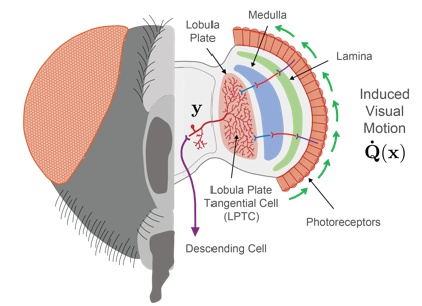
For millions of years, nature has evolved sensory systems through natural selection resulting in interesting properties in sensing. Often, these natural systems sense their environment much differently than modern engineered systems we see today. For example, most drones rely on just a few high fidelity sensors to perceive their environment and make their navigation decisions. However, in nature, more often we see that organisms have distributed sensing systems, meaning lower fidelity sensors placed all throughout the body to perceive the environment. This shifts the problem from how do I perceive my environment, to how do I make sense of the abundance of signals I am receiving to inform my actuation. The image on the right depicts a blowfly's sensory system, the compound eye. Each cell of the compound eye is tuned to sense different visual stimulus. Thus it can weight across all of the eye cells to generate a feedback signal. This greatly simplifies the signal processing compute requried while still generating useful feedback signals.
In addition, sensing is frequently put on systems as an afterthought and typically done to maximize observability. Control engineers only have so much agency over tuning knobs, thus sometimes the physical plant induces limitations on closed-loop performance. Nature has coevolved actuation and sensing together, so why shouldn't engineered systems consider the same? In other words, nature has leveraged evolution to change the plant to maximize the possible closed-loop performance in robustness, response, and efficiency. Applying similar principles to engineered systems could radically change the design process and realize performance gains previously left on the table.
Prior work has shown that the primary mechanism which drives these sensory architectures is the energy flow from sensing to actuation. Physically, this means measuring easily observable signals that the animal can efficiently act upon. It doesn't make much sense to spend processing power on signals which sense directions the animal cannot easily act upon.
Energy Flow
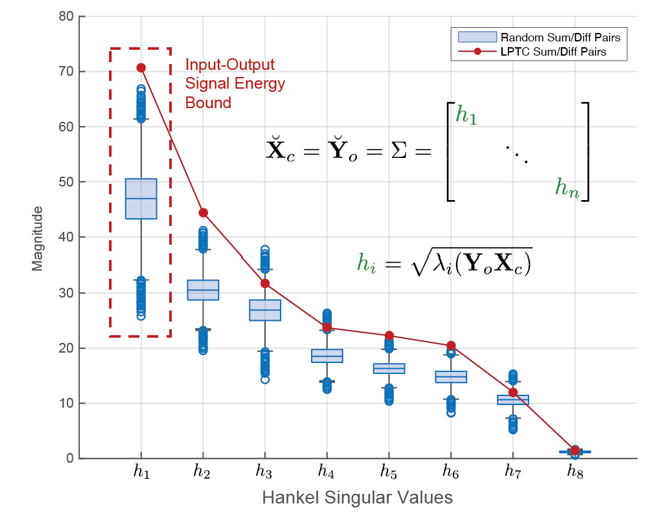
To be able to apply this natural principle to engineered systems, we must first find a metric which represents the energy flow through the system. The Hankel singular values of a system provide a metric of energy in states of the system. They do so by finding a transformation which aligns the observability and controllability gramians, to form the most jointly observabke and controllable directions. The singular vectors of this transformed system represent which directions have the most energy flow with the singular values representing how much energy is flowing through that direction respectively. Physically, this means which directions in state space are easily observable and easily actuated upon.
Metrics related to the Hankel singular values can be used as optimization criteria for optimizing the sensing of engineered systems. Different metrics associated with the Hankel singular values can lead to different sensing architectures. For example, maximizing the largest Hankel singular value, would lead to a sensing architecture which pushes the most energy through the highest energy channel. On the other hand, maximizing the L1 norm of the Hankel singular values would maximize the total energy flow through all the channels of the system.
Optimization Framework
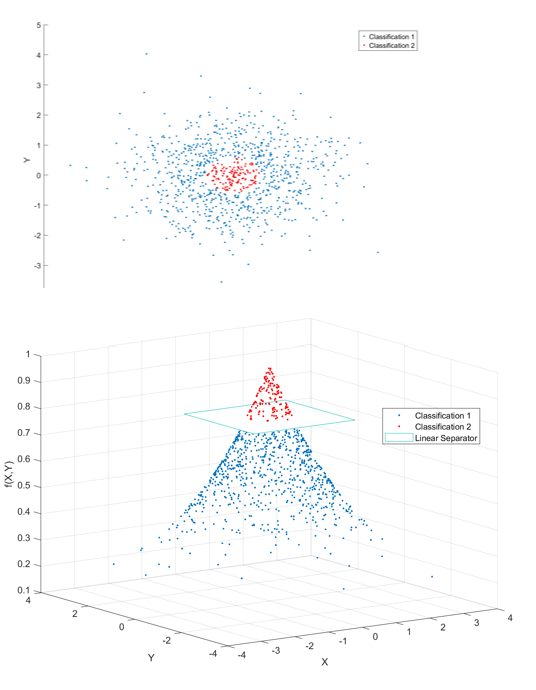
One problem posed by using these Hankel singular value metrics for optimization criteria is that they are inherently non-convex, meaning that traditional optimization techniques have difficulty finding a global optimum. To address this, we use a neural network embedding to transform the optimization problem into a higher feature space. This functions on the basis that a complex problem in low dimensional space may indeed be easier to solve in a certiain higher dimensional space. We can leverage a neural network where the weights and biases define the high dimensional feature space.
For example, consider the separation problem on the right. It is impossible to separate the blue and red points with a linear boundary, but it is easy to do so in a higher dimensional space. This is the fundamental operating principlem for support vector machines. Even so, support vector machines require user input for the kernel to make this transformation to higher dimensional space. We will use a neural network to determine this kernel for us.
Results
The results of applying this neural network based optimization (built in Python using Pytorch) indicate that this nature inspired concept can indeed be applied to engineered systems with great benefit. Functionally, by tuning the system's sensing architecture to complement its dynamics, we are able to extract the most possible performance out of the plant.
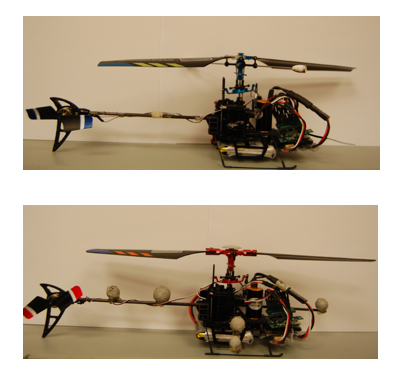
The optimization was applied to several airborne systems. To demonstrate the results, we will focus on two particular systems. The flybar and flybarless helicopters. The first helicopter has a flybar attached to it which provides an angular momentum about the z-axis. Fundamentally, this decimates most angular motion, specifically roll and pitch. When the optimization was applied to this platform, the results show that optimal sensing involves mostly sensing the linear directions: X, Y, and Z as well as the yaw direction. This is because it is very difficult for the helicopter to actuate in the other angular directions due to the flybar. It doesn't make much sense to dedicate sensory energy and processing to a direction in which it is very dfficult to actuate.
On the other hand, the flybarless helicopter is much more manueverable in the angular directions than the translational directions. Without the flybar, it becomes an unstable system. The optimization results show that it is much more beneficial to sense all of the angular directions since it is much easier to actuate in these directions. Additionally, it is also worth noting that typically to actuate in the translational directions, the system must induce angular motion too. The coupling between states means that sensing one direciton may inform other states as well. Thus by having angular information, we still can make deductions about what is happening in the translational states.
Key Achievements
- Developed novel framework leveraging neural network architectures for sensor optimization
- Successfully applied principles seen in nature to engineered systems
- Successfully constrained the non-convex optimization to provide meaningful results
- Created comprehensive framework to allow for any linear state space system to be optimized
Challenges
- Finding a way to transform the optimization problem into a higher feature space
- Wrangling non-convex optimization problems
- Constraining the optimization to prevent degenerate solutions
Solutions
- Developed a novel optimization technique utilizing a neural network architecture for sensor optimization
- Leverage high dimensional embedding to perform non-convex optimization
- Apply constraints to make the solutions physical and realizable
Results
- Produced the ability to squeeze the most possible performance from the plant through changes in sensing
- Framework gives insight to determine which sensing modes are most essential for locomotion
- Provides the ability to tune sensing for any linear state space system